


When raising startup capital, business owners tend to focus on the obvious costs and don’t take time to consider the underlying expenses.
The issue is that a capital raise is more complex than it may appear, and overlooking those costs can have long-term implications that affect business growth.
To avoid problems while fundraising, here’s a detailed guide to the key considerations you need to fully prepare for the true cost of startup capital.
The Obvious Costs vs. the Hidden Ones
When most founders think about fundraising, they tend to focus on the visible price tags, but there are also plenty of hidden costs to watch out for.
Visible Costs
The obvious costs include legal fees for drafting documents, accounting due diligence and hiring a designer for a professional pitch deck. The hours spent preparing financial models and investor travel expenses also fall under visible costs.
These costs are tangible and easy to anticipate because you’ll typically receive an invoice for them.
Most founders know to budget for these costs, and while they can be painful for your bank account, they don’t typically catch you off guard.
Hidden Costs
The real problem lies in the hidden costs. These may not arrive in your inbox with an exact price tag, but nevertheless, they can slowly eat away at your cash flow and business operations.
We’re talking about huge time sinks, where a large portion of your day is spent on startup capital planning instead of other important tasks.
Then there’s the potential loss of control over your business or the dilution of ownership. Investors have high expectations and may push for aggressive targets or pressure you to prioritize growth over sustainability.
Your company’s culture may also shift. Decisions that were once driven by customer needs now start revolving around the needs of the investors.
These hidden costs not only accumulate financially but also emotionally. The capital raising process can drain you. Especially when you realize that long-term expectations change dramatically after the first round is complete.
Future funding rounds become assumed rather than optional, so you have to keep going.
Financial Hidden Costs
Let’s go deeper into these unexpected costs, starting with the most tangible one: the financial impact.
Legal and Advisory Fees
The requirements of raising capital for a business or startup can be a legal minefield, so having the right experts on board is essential.
However, this comes with a price. Even simple funding rounds tend to cost far more in legal fees than anticipated. Every round of discussions is important, but it racks up the lawyers’ billable time.
Audits, investor rights agreements, governance discussions, contract revision, compliance review and investor-specific inputs are all charged by the minute.
Valuation Trade-Offs
Accepting a lower valuation to secure a quick close can feel like a win at the moment.
However, this lower value compounds over time, especially when going through multiple rounds of fundraising.
On the opposite end of the scale, an inflated valuation may seem like the answer, but you may get trapped in a cycle of trying to fulfil unrealistic expectations for investors. As a result, later funding rounds become more painful or even impossible without a down round (raising money at a lower valuation than the previous round).
Equity Dilution
Giving up equity in exchange for funding is a common practice, but its compounding effects are often misunderstood.
Handing over a percentage of your company to investors may not seem like a big deal at first, but it can grow to be a meaningful loss as the business scales.
You also need to factor in investor rights, such as pro-rata guarantees and liquidation preferences that quietly tip the scales in the investor’s favor.
Giving up some stake in your company isn’t necessarily a bad thing, especially if it allows you to grow in a meaningful way. However, you need to carefully think it through before closing any deals with investors.
Debt Service or Convertible Note Terms
Convertible notes and other debt-style funding tools seem straightforward, but the hidden costs are often overlooked.
Convertible notes start as debt, earning interest over time before becoming shares owned by the investor. Even if you plan to convert them into equity, that interest still adds up.
Because early investors take on more risk, they usually get to convert their notes at a lower price. A 20% conversion discount, for example, means they get more shares for the same amount of money.
On top of that, some notes have valuation caps. If the company grows quickly and the next round is priced high, early investors convert at the much lower capped valuation, creating even deeper dilution.
Strategic and Control Costs
What is starting capital going to cost you in terms of the control you have over your business? This is probably the most overlooked part of fundraising.
Loss of Control
Loss of control can be difficult to spot because it doesn’t happen overnight. It starts with investor guidance and suggestions on which growth metrics you should focus on.
Over time, those suggestions turn into expectations, even from investors who initially described themselves as “hands-off.”
Eventually, investors may start demanding board seats, observer rights, voting rights and veto powers, all of which reduce your authority and control over the direction of your business.
Shift in Business Priorities
Investors have their own ideas about where they want your business to be months or years down the road.
As such, they may push you to scale aggressively and pursue riskier strategies for faster returns.
While these priorities aren’t inherently wrong, they may not match your vision or lead to sustainable growth.
Exit Pressure
The pressure to sell your business is a major risk that you shouldn’t underestimate. Even stable businesses may be pushed into acquisition if an investor decides it’s the right time.
Conversely, if you want to sell, the action may be blocked if investors believe waiting could deliver a higher return.
Reputation Risk
Missing targets or experiencing slower growth patterns can harm your ability to secure future rounds of startup capital.
Investors talk with each other, and the pool of available funders is small. If they deem you incapable of meeting growth targets, then you’re going to look undesirable to other potential investors.
Operational and Time Costs
Time is money, yet many founders forget this when they pour weeks of effort into securing funds.
Fundraising Distraction
When you spend your whole day fundraising, you’re not focusing on growing your business.
What starts out as a part-time task quickly grows into a full-time endeavor. Before you know it, your days are spent responding to requests, refining your pitch and coordinating legal reviews.
Let’s not forget that the fundraising process isn’t quick. We’re talking three to six months of your time, which in the startup world can feel like a lifetime.
Management Bandwidth
Even after funding is secured, the work doesn’t stop. As your company grows, so does the investor group, along with all the reporting and governance obligations.
Your bandwidth gets stretched even further by investor demands for regular updates, reports and strategic reviews. Combined with governance obligations such as board meetings and documentation, the time burden quickly escalates.
Cultural Strain
Adopting a “growth at all costs” mindset can place a real strain on the culture and ethos of your business.
Team members face extraordinary pressure to move fast and get results, often without the right systems or processes to sustain the pace.
The outcome is burnout and a reduction in creativity and motivation. Worst case, your talent may jump ship to a less pressured environment. If that happens, you’ll have to factor in the cost of hiring new talent.
Opportunity
When your focus is locked on fundraising, you risk missing opportunities that could otherwise benefit your business.
Time spent fundraising is time not spent on strengthening customer relationships or closing deals. Hiring is delayed, and innovation stalls.
Meanwhile, your competitors gain ground and may start to outpace you.
Long-Term Implications
Although startups are very much focused on the short term, it’s important to consider how these hidden costs will impact you in the long term.
Future Funding Rounds
Early terms set the stage for every future round. If you have a high early valuation, it may limit your ability to raise funds in the future because your company must demonstrate extreme growth.
Always keep in mind that everything you decide during the first round of funding will affect you in some way later on.
Cap Table Complexity
A table crowded with small investors or overly generous early grants can scare off later-stage investors who prefer clean, predictable ownership structures.
Each new stakeholder introduces extra administrative burden, legal complexity and potential conflict during strategic decisions or exit negotiations.
There’s also the issue of investor fit. The wrong investor can shape the next decade of your company’s life and create friction in every major decision.
Investor turnover within a firm can introduce entirely new personalities and agendas you never agreed to work with.
Sustainability vs. Valuation
Once you raise capital, your business model changes. You commit to a growth path designed to secure future funding rounds or a significant exit.
Some founders discover later that the path they are on is not the one they want. Many would have preferred a profitable and sustainable business over a high-pressure and high-burn model.
How to Minimize These Hidden Costs
To minimize hidden costs, think carefully and ask yourself what raising startup capital will truly cost you in the short and long term.
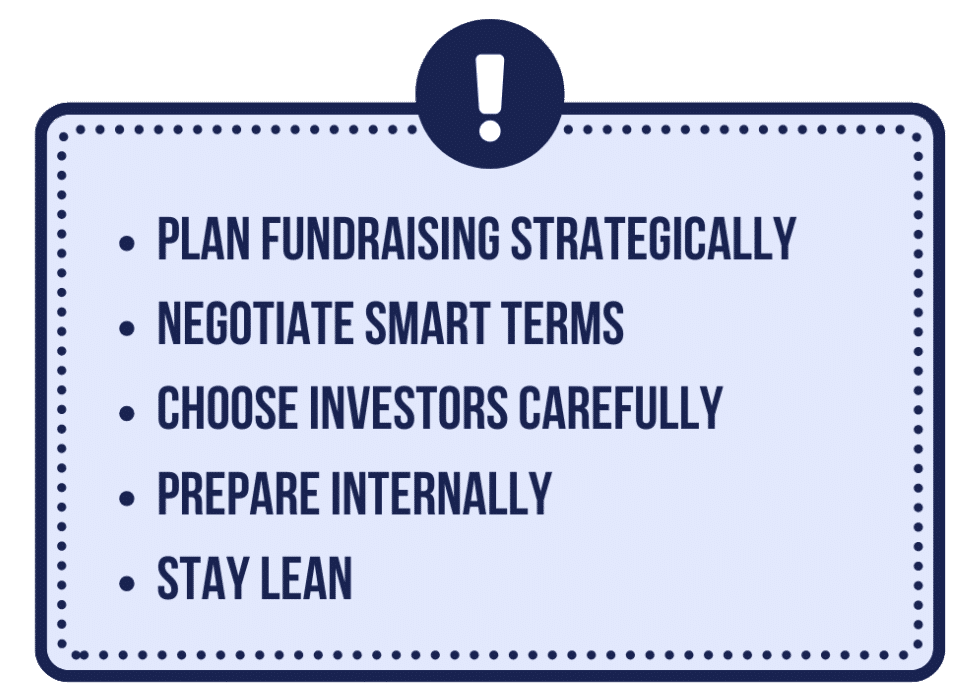
Plan Fundraising Strategically
Only raise funds when you actually need them, and only go for the amount you truly need.
Excess capital often pushes companies into premature scaling and aggressive burn rates that make your business unsustainable.
Negotiate Smart Terms
Don’t just focus on company valuation. Smart negotiation takes long-term implications into consideration.
Focus on retaining board control and protections like anti-dilution clauses and pro-rata rights.
Before you agree to them, make sure you fully understand the implications of each term and how it’s likely to affect you.
Choose Investors Carefully
Don’t choose the first investor who takes an interest.
Take the time to evaluate whether they truly understand and agree with your business model and long-term vision.
Study their track record and portfolio. Does it align with your goals? What do they do when things don’t go to plan?
The right investor will save you years of friction.
Prepare Internally
Treat fundraising as a major business change, because it is.
Like all changes, you have to implement a planning strategy to ensure your organization and team are prepared for it.
Get your legal ducks in a row as soon as possible to avoid back-and-forth with lawyers.
Work with a fractional CFO to provide strong forecasting and financial documentation. Meanwhile, an accountant can ensure your financials are clean and up to date.
Then, get your business operations into a state of readiness. Once the funding kicks in, you should be primed to take on the new growth targets. This may involve hiring new staff or investing in new systems and software to cope.
The better your preparation, the less it’s going to cost you later down the line.
Stay Lean
One of the best ways to avoid hidden costs is to reduce your reliance on external capital altogether.
Staying lean means adopting a disciplined approach to how you handle your business finances. If you’re efficient and apply strong unit economics, then you may just get by with minimal funding needs.
The less funding you require, the less you have to sacrifice for your investors. When you do need to secure investment, you’ll hold more power during negotiations because you know how to survive with minimal funding.
Final Thoughts
Raising money can accelerate a company’s growth, but only when founders understand the full picture of what they’re signing up for.
That’s why having a clear understanding of startup capital matters more than most founders realize. Capital isn’t just money. It’s expectations, obligations, timelines and trade-offs.
On top of that, having professional help at hand can help you make sense of this complex process.
At Finvisor, we specialize in providing expert accountants and financial experts to startups in various industries.
If you’d like to learn more about our services, we invite you to get in touch.

Let's chat
Get on our calendar for a free introductory call.Find out what it's like to work with Finvisor and how we can help you reach your business goals. Our financial advisors work hard for your business across our full suite of accounting and reporting services.
Request a Quote
We'll get back to you within a business day, usually sooner. Or you can schedule an introductory call and get on our calendar."*" indicates required fields
