
Most business owners dread year-end tax planning because it means scrambling for paperwork and working overtime.
However, we’re here to flip the script and transform small business tax strategies into an opportunity rather than a hassle.
All it really takes is some smart decisions and savvy planning to maximize tax savings and reduce your liability.
Here are a few practical steps to get you moving in the right direction.
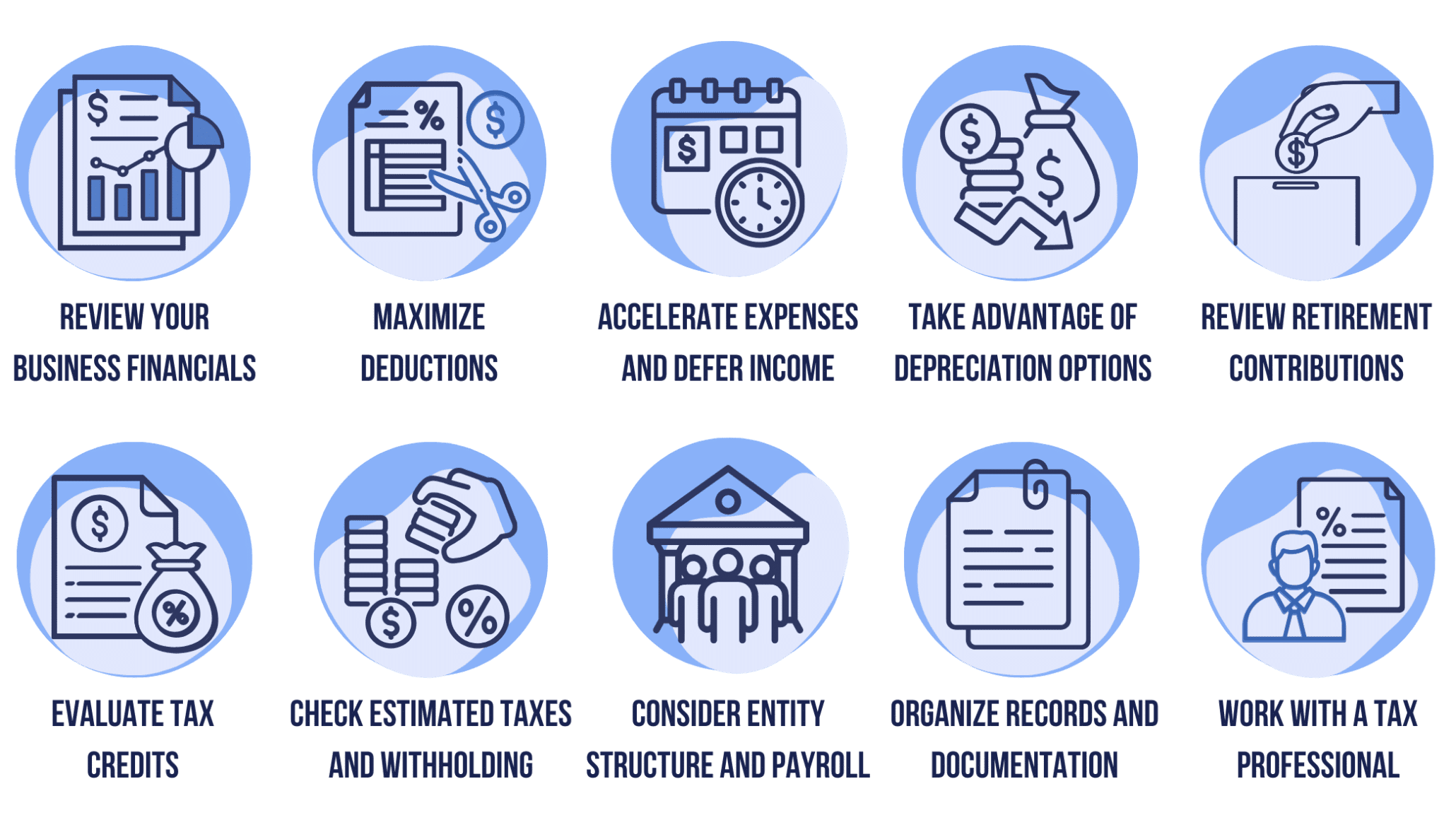
Review Your Business Financials
Before you start filling out tax forms, take a step back and get clear on where your business stands financially. You need to understand precisely how much your business actually earned and spent, which means reviewing the figures in black and white.
Start by pulling a year-to-date and full-year profit and loss statement, balance sheet and cash flow statement.
Review them line by line. This information will tell you where your taxable income will land and which actions you must take before year-end.
This information also reveals:
An estimation of your tax liability
Any expenses that you forgot to record
Areas or trends where income and expenses were higher or lower compared to the previous year
This is the point where you want to pause to get your books tax-ready. This includes reconciling every account, loan and credit card to your year-end statements and fixing any miscodings.
Maximize Deductions
Taxes for small businesses can be significantly reduced by taking advantage of deductions. However, the spending must take place (and be paid or placed in service) before December 31st.
Before year-end rolls around, ask yourself:
Are all paid expenses properly documented?
Am I mixing personal and business expenses in a way that affects deductions?
Are there any business expenses that I’ll definitely incur next year that could be paid for now?
Common small business deductions include:
Office expenses like supplies, postage, printer ink, SaaS tools, subscriptions, office rent and IT equipment
Phone and internet used for business purposes
Travel expenses like transportation tickets, mileage, accommodation, meals, and site or entry fees to business-related conferences and training
Home office equipment and share of rent or mortgage interest, utilities and repairs
Business vehicle purchases
Here are a few extra things to note to help you maximize your deductions:
Make sure recurring services are invoiced and recorded before closing the books.
Assets must not only be purchased but also placed in service before year-end.
It can be beneficial to prepay up to 12 months of next year’s recurring costs before year-end.
Keep the business and personal portions of expenses clearly documented and separated to ensure that only the business portion is deducted.
Accelerate Expenses and Defer Income (When Appropriate)
This is one of the most strategic aspects of small business tax planning because it helps reduce current taxable income.
When you’re going through your expenses and income, pay attention to timing.
In some cases, it makes sense to accelerate expenses (pay them before year-end). In other situations, deferring income (delaying invoicing or payments until January) is a smarter move.
Situations where accelerating expenses make sense are when:
You have had a strong financial year.
You expect to fall into a lower tax bracket next year.
You have the available liquidity to comfortably make the purchase.
Delaying income until next year works when:
You don’t immediately require the cash.
Payment timing isn’t a contractual obligation.
Clients allow delayed invoicing.
That said, income deferral should be used thoughtfully and only when it truly makes sense. If you keep deferring income every year, you may end up with distorted financial statements and larger tax liabilities down the road.
Take Advantage of Depreciation Options
Depreciation is simply a way to deduct the cost of certain business assets over time. With some strategic planning, you may be able to accelerate cost recovery, which can help reduce your taxable income.
That’s where tools like Section 179 and bonus depreciation come in, allowing qualifying equipment, vehicles, software and furniture to be written off faster.
Section 179
Under Section 179, you can currently get an immediate full reduction of qualifying purchases up to a total of $2.5 million, with a deduction phase-out for each dollar over a $4 million threshold.
For instance, if you purchase a $5,000 computer, you’d typically deduct a portion of that cost each year. With Section 179, you may be able to deduct the entire $5,000 immediately.
This strategy works best if you need cash flow relief right now.
Common qualifying items include:
Computer and IT equipment
Machinery and tools
Office furniture
Business vehicles
Some software (not custom-built)
Items that do not qualify include inventory, land and buildings. You also cannot claim depreciation on assets that are used less than 50% for business purposes.
It’s worth pointing out that using Section 179 is optional. You can choose regular depreciation instead and claim it over time. This is a better option if your income tends to fluctuate or you prefer to have steady depreciations rather than it all upfront.
Bonus Depreciation
100% bonus depreciation has been restored for qualifying new/used equipment, improvement property and some real estate, as long as purchases were placed in service after January 19, 2025.
For example, you can now get a 100% first-year write-off for qualified production property, instead of 39 years.
Also, there is no dollar limit, making it a good option for large purchases.
One strategy is to accelerate purchases if you have had a high-income year, since this will give you bigger tax savings. Another is to opt out and preserve the bonus depreciation for future low-income years.
A solid overall strategy is to use Section 179 for assets under the limit to frontload your deductions, then apply bonus depreciation to any excess amounts.
A word of caution: bonus depreciation rules can change year by year, so always check the latest information or consult with a tax professional to ensure you don’t end up losing money through depreciation strategies.
Review Retirement Contributions
Retirement contributions have a twofold benefit: they reduce federal taxes for small business owners while also building long-term savings.
Employer contributions for qualified plans are 100% deductible as a business expense in the year made, without double taxation (because deductions are made on the business return, then contributions grow tax-deferred).
Key plans include:
Solo and individual 401(k): Owners contribute up to $23,500 plus 25% of compensation as a profit-sharing or employer match (total $70,000 or $77,500 for those over 50).
SEP IRA: Employer contribution of up to 25% compensation or $70,000 (whichever is less).
SIMPLE IRA: Employee deferral of up to $17,000, plus employer match of 2-3%. Startup credits are available for smaller firms.
A good tip to help you fine-tune taxable income down to the desirable bracket is to max employer portions late in the year.
For calendar-year plans, you typically have until your tax filing deadline to fund these contributions (e.g., March 15 for S-corporations, with extensions; October 15 for a SEP IRA if extended).
Evaluate Tax Credits
End-of-year tax liability can be large for small businesses, but the right tax credits can significantly ease the burden, provided you know exactly where to look for them.
Let’s take a look at some common tax credits, plus a few lesser-known ones you might qualify for:
Work opportunity tax credit: Up to $9,600 per eligible new hire from targeted groups like ex-felons, veterans and long-term unemployed.
Paid family and medical leave credit: Up to 25 to 40% of eligible wages paid to employees on qualified leave.
Clean energy production credit: Per-kWh or per-component credit for clean energy manufacturers.
Energy-efficient commercial buildings deduction: Up to $5 per square foot for energy-efficient building retrofits.
Alternative fuel refueling property credit: 30% of costs for hydrogen stations, EV chargers, etc. ($100,000 max per facility).
SECURE 2.0 startup credit: New retirement plans get credit for covering admin and setup fees (up to $5,000 per year) for three years, plus $1,000 employee credit on contributions.
Disabled access credit: 50% of eligible access adaptations (ramps, signage, interpreters, etc.), $5,000 max.
R&D tax credit for small businesses: 14 to 20% of qualified research expenses with up to $500,000 offset against employer taxes.
Check Estimated Taxes and Withholding
When paying taxes, small business owners must take care to avoid underpayment penalties. The good news is that with a little planning ahead, they’re entirely avoidable.
Before your accountant flags an underpayment issue (and well before year-end):
Compare what you’ve paid in estimated taxes against what you’re likely to owe.
If your income has increased, adjust the final payments to correspond.
Also review withholding if you have both business and W-2 income.
Making a quick catch-up payment is far better than incurring interest and penalties later.
Consider Entity Structure and Payroll
Your business structure has a direct impact on the amount of taxes you pay. The setup that may have fit your business initially may no longer be efficient and might actually be costing you more in the long run.
As an example:
Sole proprietors pay a self-employment tax of 15.3% on all net profits, with no payroll flexibility.
S-Corp owners take a reasonable salary, which is subject to FICA payroll taxes. The remaining profit avoids self-employment tax and is only subject to income tax.
Partnerships or LLCs pay a self-employment tax on guaranteed payments, while distributive shares avoid it.
While December is definitely not the ideal time to change entity structure, this is something you should periodically evaluate. Changing your business entity takes time and effort, but the potential tax savings can make it well worth considering.
Similarly, payroll taxes can be optimized, depending on the business structure. For instance, S-Corps can deduct accrued bonuses if they are paid within 2.5 months of year-end.
Organize Records and Documentation
Corporate tax planning has and always will require meticulous documentation and organization.
You have a few options here:
Hire a tax professional to organize everything for you
Use accounting software
Manually record everything onto spreadsheets
We recommend a mixture of options one and two. We’ll get into hiring a professional in a moment, but one of the best first steps you can take is investing in solid accounting software designed for small businesses.
Not only will it automate many of the mundane processes like transaction categorization, but it’s also highly accurate and will maintain and update records on your behalf.
Don’t rely on paper records. This is a recipe for disaster. Instead, upload digital copies of everything so you have concrete proof of all expenditure.
Here’s what you need to have in place to get ready for year-end:
All accounts reconciled
All transactions with correct categorization
Core financial statements (profit and loss, cash flow summary, prior year tax return)
Fully tracked expenses, mileage logs, receipts and invoices matched to expenses
Asset registers with depreciation schedules
W-2s and 1099s summaries
Before meeting with your CPA or tax preparer, get all these documents ready and compile them into a single shared folder or tax portal upload.
Some key areas to discuss when meeting with your accountant include:
Your current taxable income projection and any reduction targets
Reviewing your entity structure and payroll
Any possible moves you can make before year-end, such as pre-paying expenses or bonuses
Any state or industry-specific issues or nuances around how to report taxes for small business entities
Work with a Tax Professional
For small businesses, good financial management makes all the difference, and taxes are a big part of getting it right.
Unfortunately, taxes are a minefield, and the rules frequently change.
Therefore, hiring a tax professional can be an incredibly wise investment for your small business. Not only will they save you time and stress, but they can also ensure you maximize credits and deductions while reducing your overall liability.
Finvisor specializes in outsourced financial expertise for small businesses just like yours. You’ll be able to hire the right professional at the right time to handle specific tasks.
With Finvisor, you get access to experienced professionals who can guide you through everything from tax planning and credits to CFO services and long-term financial strategy.
For more regular financial management, our team provides regular accounting, bookkeeping, payroll, and HR services.
Specializing in many industries, including AI, biotech, ecommerce, and more, we know the subtle differences and laws that affect taxable income.
For more information, we invite you to get in touch and chat with our team.


