Raising early stage capital is one of the most critical and often most confusing challenges a startup founder will face. Before a company has a formal valuation, before a priced funding round, and sometimes before there is a clear product-market fit, founders need a way to bring in capital.
SAFE and convertible notes are startup financing instruments that allow investors to provide capital in exchange for future equity. A SAFE converts into shares at a later funding round without accruing interest, while a convertible note functions as debt that converts into equity, typically with interest and a maturity date.
Both instruments are designed to allow startups to raise capital quickly without setting an immediate valuation. This simplifies early-stage fundraising and allows founders to defer pricing the company until a later round when there is more traction, more data and a stronger negotiating position.
In this guide, you’ll learn how SAFE agreements and convertible notes work, how they differ and what founders should consider when deciding which instrument best fits their fundraising strategy.
Understanding SAFE and Convertible Notes
SAFE and convertible notes are early-stage funding tools used by startups to raise capital before a formal valuation. While both are designed to defer valuation decisions until a later funding round, they differ in structure and terms.
A SAFE agreement converts into equity in a future funding round without being structured as debt.
In contrast, convertible notes are debt instruments that convert into equity, often including interest and a maturity date.
Despite these differences, both instruments commonly include valuation caps and discounts for early investors.
By allowing startups to secure funding quickly while postponing formal valuation negotiations, SAFE agreements and convertible notes can provide valuable flexibility during the early stages of growth.
What Is a SAFE?
A SAFE, or Simple Agreement for Future Equity, is a financing instrument developed by Y Combinator in 2013. It was designed to replace the convertible note as the standard early-stage fundraising tool by removing the complexity that comes with a debt structure.
A SAFE is not a loan. It does not accrue interest, it does not have a maturity date, and it does not create any obligation for the startup to repay the investor. Instead, it is an agreement that gives the investor the right to receive equity in the company at a future funding round, at terms that are defined in advance.
SAFEs are generally simpler and faster to execute compared to convertible notes due to fewer legal components. This makes them especially popular in seed-stage funding when speed and flexibility are priorities.
Key Terms in a SAFE
Valuation cap: A valuation cap sets the maximum company valuation at which the investor’s SAFE will convert into equity. It protects early investors by ensuring they receive a favorable ownership percentage if the company’s valuation increases significantly before the next funding round.
Discount rate: A discount rate gives SAFE investors the right to convert at a lower price per share than future investors at the next priced round, rewarding early investors for taking on more risk.
Pro-rata rights: Some SAFEs include pro-rata rights, which give investors the option to maintain their ownership percentage in future funding rounds by participating in those rounds.
Pre-Money vs. Post-Money SAFEs
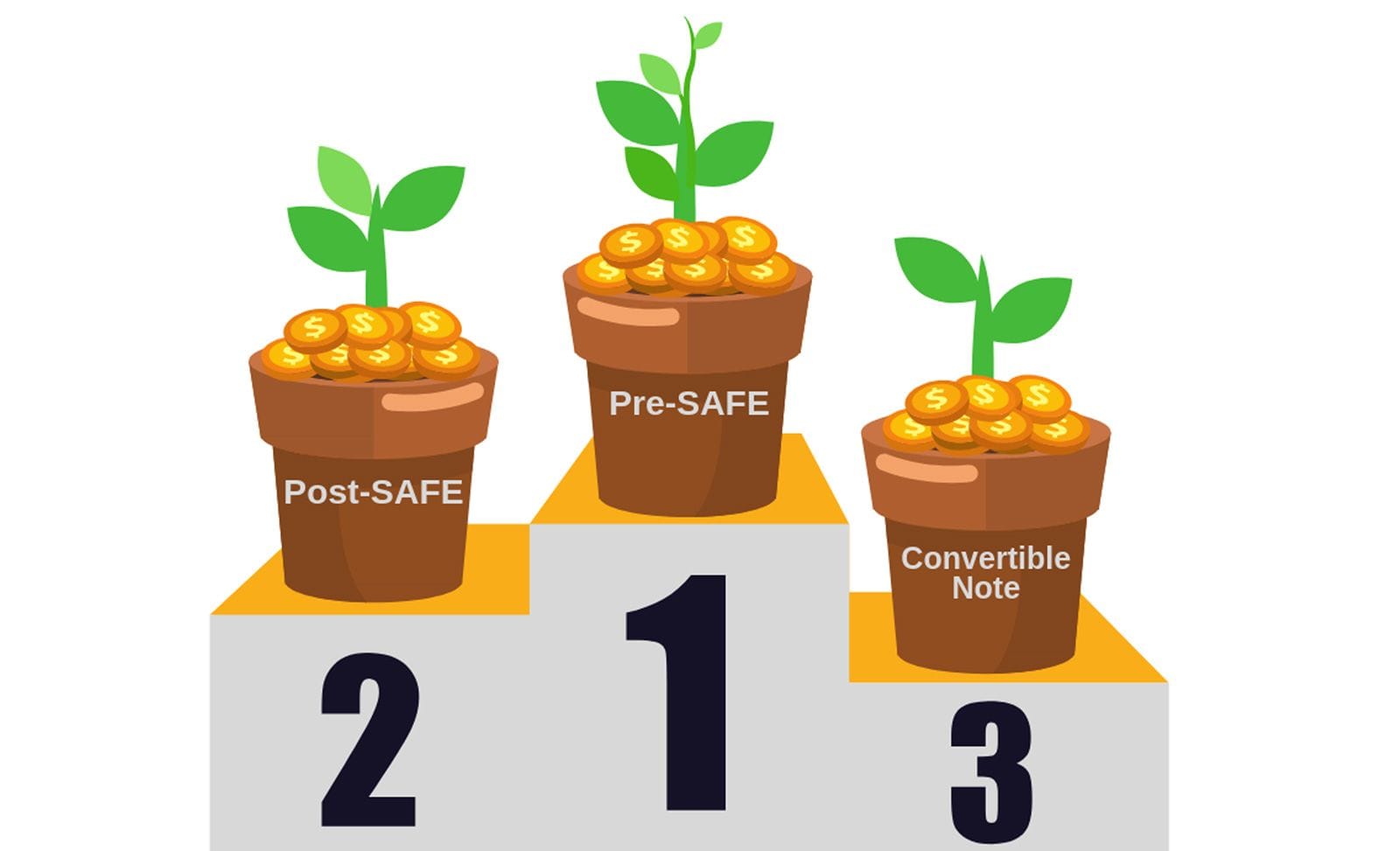
The original SAFE structure used a pre-money valuation cap, meaning the cap was applied before accounting for the capital raised in the SAFE round itself. Y Combinator updated the standard SAFE in 2018 to use a post-money valuation cap, which makes dilution calculations more transparent and predictable for both founders and investors.
Post-money SAFEs are now the standard. Founders raising capital using SAFEs should understand how the post-money structure affects their ownership at the time of conversion, particularly when multiple SAFEs are outstanding before the next priced round. SAFE holders convert their investment into shares issued at the point of the next qualifying financing round.
What Is a Convertible Note?
A convertible note is a debt instrument that converts into equity at a future funding round, typically including interest and a maturity date. Unlike a SAFE, a convertible note is legally structured as a loan, which means the startup is technically obligated to repay it if conversion does not occur before the maturity date.
Convertible notes introduce repayment risk through maturity dates and accrued interest. If a startup has not closed a qualifying funding round before the maturity date, the investor may have the right to demand repayment, extend the note or convert at a negotiated rate.
That said, convertible notes are often preferred in situations where investors want additional protection or where the funding environment calls for a more formal debt structure.
Comparison of Early Stage Financing Instruments
The table below provides a structured comparison of SAFE agreements, convertible notes and alternative financing instruments, helping founders evaluate which structure best fits their current stage and investor expectations.
| Criteria | SAFE | Convertible Notes | Priced Equity Round | Revenue Based Financing |
|---|---|---|---|---|
| Cost | Lower legal and administrative cost | Moderate legal and administrative cost | Higher legal and structuring cost | Varies based on repayment terms |
| Commitment | No repayment obligation | Debt obligation until conversion or maturity | Equity issuance with formal valuation | Ongoing revenue based repayment |
| Scope | Converts to equity in future round | Converts to equity with debt structure | Immediate equity ownership issued | Non equity financing tied to revenue |
| Ideal use case | Early stage startups seeking fast capital | Startups comfortable with debt structure and timeline | Startups ready for formal valuation | Startups with predictable revenue streams |
| Strategic impact | Faster fundraising with deferred valuation | Adds complexity and potential repayment risk | Establishes valuation and ownership structure | Preserves equity but impacts cash flow |
| Investor expectations | Common in early stage and angel investing | Often used when investors want additional protection | Preferred by institutional investors | Used by alternative funding providers |
| Dilution considerations | Based on cap and discount at conversion | Based on cap, discount and accrued interest | Defined at time of investment | No equity dilution |
SAFE vs. Convertible Notes: Key Differences
For startup founders, the choice between SAFE and convertible notes is a strategic financing decision rather than a purely legal one.
The structure selected affects dilution, investor alignment and future fundraising dynamics, making it important to align the instrument with long-term capital strategy.
Debt structure: A SAFE is not debt; a convertible note is.
Repayment risk: SAFEs have no maturity date, while convertible notes may require repayment if they do not convert in time.
Simplicity: SAFEs are generally faster and less expensive to execute.
Investor expectations: SAFEs are common in early stage and angel investing, while convertible notes may be preferred when investors want additional protections.
Dilution: Both instruments dilute founders when they convert, but convertible notes may result in slightly greater dilution due to accrued interest.
Valuation Caps and Discounts: Why They Matter
Valuation caps and discounts significantly impact founder dilution in future funding rounds.
A valuation cap protects investors by setting a ceiling on the valuation at which their investment converts. A discount rate provides a similar benefit by allowing the investor to convert at a percentage below the price per share in the next round.
When both a cap and a discount are present, the investor typically receives whichever term provides the greater benefit at the time of conversion.
When Should a Startup Use a SAFE vs. a Convertible Note?
There is no single right answer, but there are patterns that tend to guide the decision:
Use a SAFE when you want the simplest and fastest path to closing a round and want to avoid repayment risk.
Use a convertible note when investors require additional protections such as interest accrual or a maturity date.
Consider a priced equity round when the company has enough traction to establish a defensible valuation.
Investor expectations may differ based on instrument choice, especially in institutional funding environments. Founders should discuss instrument preferences with their investors early in the process to avoid friction later.
Conclusion
SAFE agreements and convertible notes have made early-stage fundraising faster and more accessible for startup founders. By deferring the valuation conversation to a later, better-informed moment, both instruments allow startups to close rounds quickly and maintain momentum without the friction of a full priced round.
The right choice depends on your investors, your timeline and your long-term capital strategy. SAFEs offer simplicity and eliminate repayment risk. Convertible notes offer additional investor protections that can make certain funding relationships more comfortable. Understanding the mechanics of both gives you the tools to raise capital on terms that work for your business.
Finvisor provides financial and strategic guidance for startups navigating early-stage fundraising, including the use of SAFE agreements and convertible notes. By connecting capital structure decisions with long-term financial planning, Finvisor supports founders through complex financing and growth stages.
If you need help evaluating the right funding structure for your startup, get in touch with our team.


