Your team plays a crucial role in your company’s success. By paying them on time, managing benefits, and handling tax forms, you show that you value their work and help keep your business running smoothly.
However, as your business grows, managing payroll on your own can become overwhelming. When that happens, outsourcing can be a winning and affordable solution that benefits both your business and your team.
In this article, we’ll explore exactly what outsourcing means for payroll and how you can ensure you pick the right provider for your needs.
What Is Payroll Outsourcing?
In a nutshell, payroll outsourcing is the process of hiring a third-party service to manage and facilitate your organization’s payroll instead of taking on an in-house member of staff.
Payroll outsourcing services can range from basic payroll processing to a comprehensive solution incorporating staff benefits and broader HR administrative tasks.
Some of the key responsibilities a payroll provider can do for you are:
Calculating and paying staff wages and taxes
Direct deposit setup for payment of staff wages
Local, state and federal tax management and payment
Issuing and processing W-2 and 1099 forms
Setup and ongoing management of employee self-service portals
Integration with HR, timekeeping and accounting systems
Staff benefits administration, such as PTO, health insurance and retirement
Compliance monitoring and reporting
Handling of wage garnishments, new hires and terminations
Handling of employee payment disputes
The Benefits of Using a Payroll Outsourcing Service Provider
Many startups and smaller businesses start out by handling payroll themselves. But as the company grows, this quickly becomes a complex and time-consuming task.
Instead of going through the lengthy process of hiring an in-house payroll professional, a business can simply outsource the role, which relieves them of the burden of doing it themselves.
The advantages of outsourced payroll providers cannot be underestimated.
Most business owners simply don’t possess the deep knowledge and expertise required for efficient payroll processing. This may lead to an increased number of payment disputes and errors, which can end up costing the business more than anticipated.
In contrast, outsourced payroll services provide qualified individuals who can use advanced systems to minimize errors and ensure compliance is upheld throughout the payroll process.
And let’s talk about cost. Many assume that an outsourced service is expensive. However, when you compare it to the cost of an in-house hire, you may find that it’s actually a very affordable solution.
When you outsource, you only pay for the services you need—no salaries, no benefits, no workspace. Plus, these services are typically scalable, allowing you to adjust based on your company’s changing needs.
Hiring in-house adds another layer of complexity. You must pay for a full-time salary no matter what, plus benefits, PTO, office space and equipment.
There’s also a hidden benefit to outsourcing payroll that many companies overlook: when employees are paid properly and on time, they are more content. As a result, the business enjoys a lower turnover rate, increased morale and a higher reputation as an employer.
Signs You Need a Payroll Outsourcing Provider
It’s not always immediately clear when it’s time to outsource your payroll. However, there are a few key signs that suggest you might want to make a change.
Your Company is Growing Larger
Handling one or two staff members’ wages is generally straightforward, but what happens when you take on several more team members?
What started as a quick task suddenly eats up a significant portion of your time. As payroll demands increase, other tasks are left unattended while you’re tearing your hair out, trying to make sure everyone gets paid.
If this resonates with you, then it’s definitely time to switch to a payroll professional.
You’re Making Errors
Another surefire sign you need to make the switch is if you’re encountering errors or compliance issues such as miscalculating overtime or filing late tax returns.
One significant challenge is that laws and regulations surrounding payroll frequently change. If you don’t keep up with these changes, you’re putting your business at risk of fines and legal issues.
In addition, many small business owners lack access to efficient payroll systems, and manual processes increase the likelihood of mistakes.
Modern payroll platforms can automate most of the data gathering, which drastically reduces miscalculations. Outsourced payroll experts have the necessary skills to set these systems up and keep up to date with the frequent changes surrounding compliance.
You’re Expanding Nationally or Internationally
If your business is in the fortunate position where it is ready to scale and expand into other states or countries, your responsibilities are about to get much more complex.
While managing your own state’s laws and regulations is one thing, managing multiple sets of rules is quite another. Each state has varying laws regarding wage payments, taxes, and compliance requirements.
It gets even more complicated when you expand internationally. In other countries, the landscape can shift entirely and may look completely different from what you’re used to.
If you don’t know how to navigate this change properly, then it’s time to get an expert on board.
Key Factors to Consider When Choosing a Payroll Provider
Although switching to HR payroll outsourcing is less complex than hiring an in-house staff member, it’s not a decision that should be made quickly or taken lightly.
Just like you wouldn’t pick the first candidate from an interview lineup, you shouldn’t just go with the outsourcing firm that appears at the top of a Google search.
There’s a lot of due diligence to perform. The provider you choose must align with your business needs, and you have to feel comfortable with the person you’re assigned.
Here’s what you need to look for.
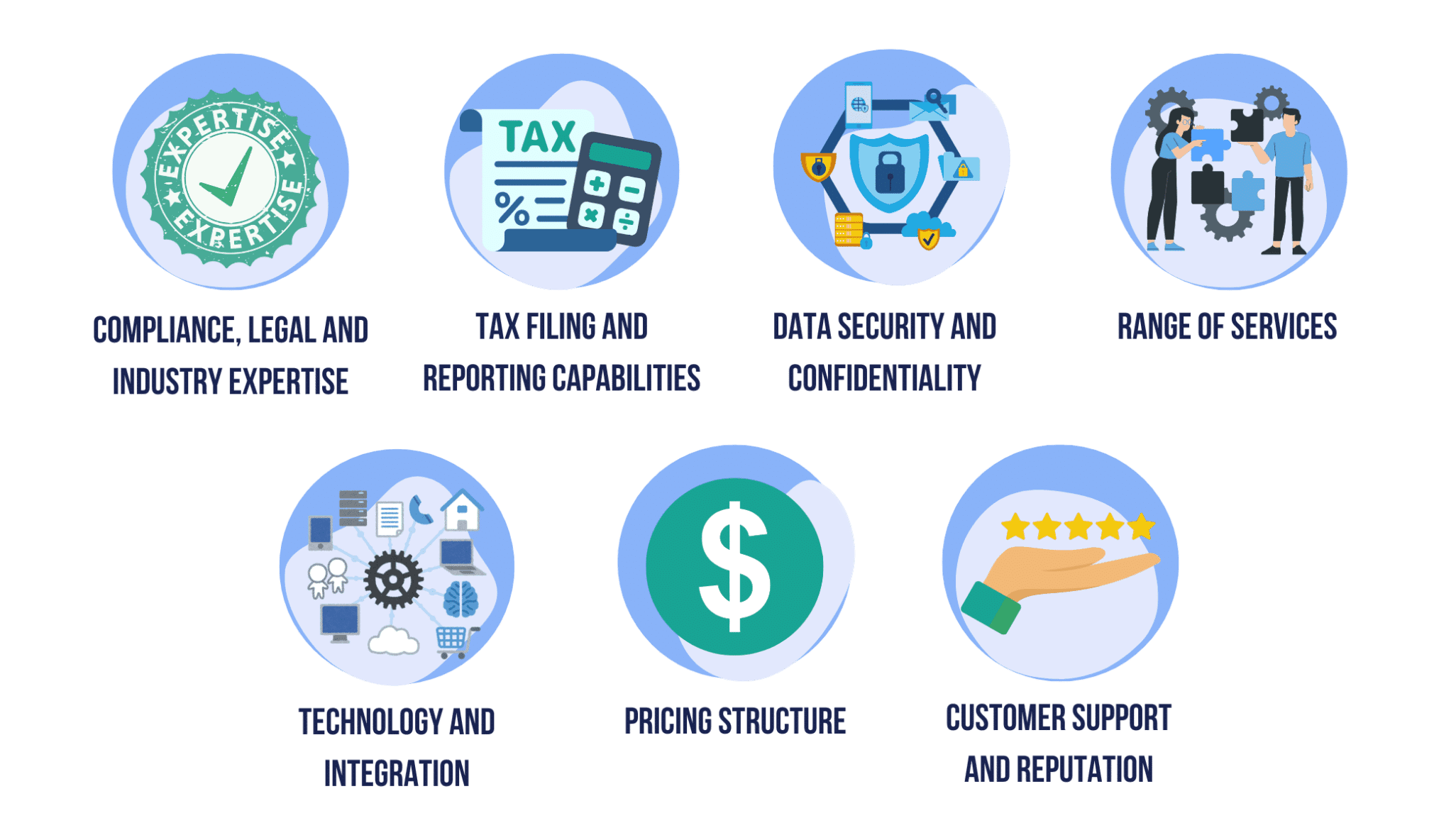
Compliance, Legal and Industry Expertise
Compliance is non-negotiable. Besides understanding federal law inside out, your payroll provider must have strong knowledge and expertise in your local and state regulations.
Keep in mind that outsourced payroll is a remote service, so the chances are, they won’t be based in your state. Therefore, check that they have experience or knowledge in running payroll wherever your business is based.
If your business is international or hires global remote workers, they also need to know how to handle this properly.
It’s also highly beneficial to pick a provider with strong experience in your industry. Many industries require niche knowledge. For example, government contracting requires DCAA compliance and adherence to several federal acts, while the healthcare industry requires HIPAA compliance.
If your payroll provider knows how to adhere to these specific rules, then they will be able to serve your business without extensive training and onboarding.
Tax Filing and Reporting Capabilities
Filing taxes should not be a rush job to meet a looming deadline. An efficient payroll provider will have everything compiled and ready to file on time, every time.
They should be able to efficiently handle all the necessary forms and any other state-specific documents and manage tax payments on your behalf.
Look for providers that use clear reporting tools so you can track any liabilities and deposits in real time. If a provider also offers audit support, it’s a strong sign of accountability and professionalism.
Data Security and Confidentiality
HIPAA, CCPA, GLBA, PIPEDA, GDPR… No matter what laws apply to your business operations, it’s vital to follow all rules around data confidentiality and how data should be handled.
The payroll provider must be able to demonstrate they are up-to-date and compliant with these complex data privacy laws.
To support this, they must use secure, modern systems that apply the following:
Full data encryption when data is in transit and at rest
Secure portals that utilize access control and authentication
Secure file transfer protocols
Audit logging and monitoring
Regular security testing, updating and data backups
Ask the provider about their cybersecurity protocols and how they handle data. Also inquire about the types of systems they use.
Range of Services
It’s a good idea to think beyond your current needs and consider what your business might need in the future. While you may only need basic payroll services right now, as your business expands, so will your service requirements.
Look for a provider that has a wide range of services that you can opt into as needed. For instance, Finvisor offers accounting, bookkeeping, compliance, and other financial services on top of payroll and HR functions.
This wide offering allows you to offload all your day-to-day operations in one place, providing a convenient, centralized solution that reduces the need to juggle multiple outsourced vendors.
Technology and Integration
Any respectable payroll provider will insist on using modern technology to facilitate and automate day-to-day tasks and data management. If they don’t, then this is a red flag that they are not remaining current within the industry. Manual or outdated systems may not comply with security regulations.
Choose a provider that uses secure, cloud-based platforms that integrate natively with accounting, HR and timekeeping systems. The system should also provide automated alerts and customizable reports as standard.
Pricing Structure
Pricing should be completely transparent. No matter what type of pricing structure is offered, clarity and honesty are non-negotiable.
If you find the provider is vague or skirts around the question of pricing, definitely avoid them.
Hidden fees are more common than you think. What initially appears to be a budget-friendly option can quickly become costly once add-ons and unexpected charges are factored in.
Think carefully about the pricing model that best suits your business. Some providers charge a flat fee for a package of services, while others charge per employee.
For example, Finvisor has several pricing tiers to suit business needs with a range of clear add-on services that you can scale up or down as required.
Customer Support and Reputation
When issues arise, especially urgent ones, you need to trust that your provider will respond quickly and effectively.
Inquire into the level of customer service you can expect, the response times to queries, and what will happen if there’s an emergency.
You should also ask about methods of communication. Do they only respond to emails, or do you also get access to a phone line, live chat or Slack channel?
Online reviews are a great indication of what the customer service and overall company reputation are like.
Be sure to thoroughly check reviews and look for recurring themes around responsiveness and service. While the odd bad review is usually nothing to worry about, multiple negative reviews around recurring themes are worth being concerned about.
Questions to Ask a Potential Payroll Provider
Once you have narrowed down your search to a handful of potential providers, it’s time to get in touch and start gathering information.
Prepare a list of questions that you want to ask. Don’t be afraid to ask as many as you need. A reputable provider will expect them and will be more than happy to answer them.
To help, here are some key questions you should ask:
What is your experience within my state and industry?
Can you handle multi-state or international payroll?
Do you support Earned Wage Access (EWA) or on-demand pay? (if required)
What’s included in your standard package, and are upgrades available?
Are there any additional costs or add-ons?
Am I locked into a contract? If so, how long is it?
How do you ensure tax compliance and accuracy?
How do you stay updated on changing tax, labor and compliance laws?
What systems and platforms do you use to facilitate payroll and communication? What are the security protocols?
Can your technology integrate with my existing systems?
How do you minimize payroll errors?
How do you handle disputes, compliance issues and IRS notices?
What support is available if something goes wrong?
Do I get a dedicated account manager?
Can you provide references from clients with similar businesses?
What is your average retention rate?
Final Thoughts
For growing businesses, outsourcing payroll can be a smart and strategic move.
By handing off this time-consuming responsibility to experts, you free up valuable time and headspace to focus on scaling your business. Meanwhile, you can rest easy knowing your team is being paid accurately, on time, and in full compliance with the latest regulations.
The first step is to find a reputable provider, and we invite you to consider Finvisor.
Our professional payroll and HR services are made for startups and small to medium businesses, and we have amassed over a decade of experience in multiple complex and cutting-edge industries.
To find out more about our offerings and services, we would love for you to get in touch.