
Knowing how much your business is worth is beneficial for many different reasons beyond preparing for a sale. Valuation can also help you grow your operations, secure much-needed funding and understand your company’s financial health.
Valuation is not just about revenue. It’s a comprehensive look at your whole operations to assess how strong, scalable and investment-ready your company really is.
In this guide, you’ll learn how valuation works, what drives your company's worth and how to use that knowledge to plan your next move.
Why Knowing Your Business's Value Matters
With a valuation, businesses can learn more than simply how much their organization is worth. Here are several critical areas where having a valuation is essential.
Strategic Planning and Growth
Knowing the value of your business plays a key role in your growth strategies because it allows you to understand strengths, weaknesses and any opportunities to improve. Having this insight is crucial for making decisions that will propel your business forward.
Essentially, a business valuation provides a baseline for performance. With it, you can set clearer goals, plan smarter investments and make confident decisions about hiring, spending and cutting costs.
Raising Capital or Attracting Investors
Investors want to place their money in a reliable and solid business that can demonstrate it has strong financial health and market viability.
If you plan to seek funding or attract investors, you need a clear valuation on hand so you can present a solid case for your business’s growth potential.
Business valuations prove to investors that you are credible and trustworthy. This makes it a lot easier not only to get accepted but also to secure more favorable terms.
Preparing for Sale, Merger or Acquisition
Getting ready for a sale is one of the most obvious reasons why you need a company valuation. After all, you need a clear, accurate picture of its worth to understand how to price your business for sale before you can put it on the market.
The same goes for mergers and acquisitions. Knowing the worth of your business is key to securing favorable terms and receiving fair market value.
The risk of not getting a valuation is underpricing or overpricing the value. If you underprice your business, a sale will result in massive financial loss, while overpricing will deter potential buyers.
Succession or Estate Planning
If you aim to pass the business onto heirs or family members, then having a firm valuation establishes the fair market value in order to set the transfer or sale price.
It also makes the transition process smoother. When values are clearly established up front, there is a much lower chance of suffering disputes as the business changes hands.
Additionally, the valuation is necessary for tax planning and determining any liability for estate or gift taxes. Not only will you stay on the right side of the IRS, but valuation will also help avoid any unexpected tax burdens.
Common Methods to Value a Business
There are three key methods for conducting a valuation of business assets and profitability. The one you choose will depend on the type of business you own.
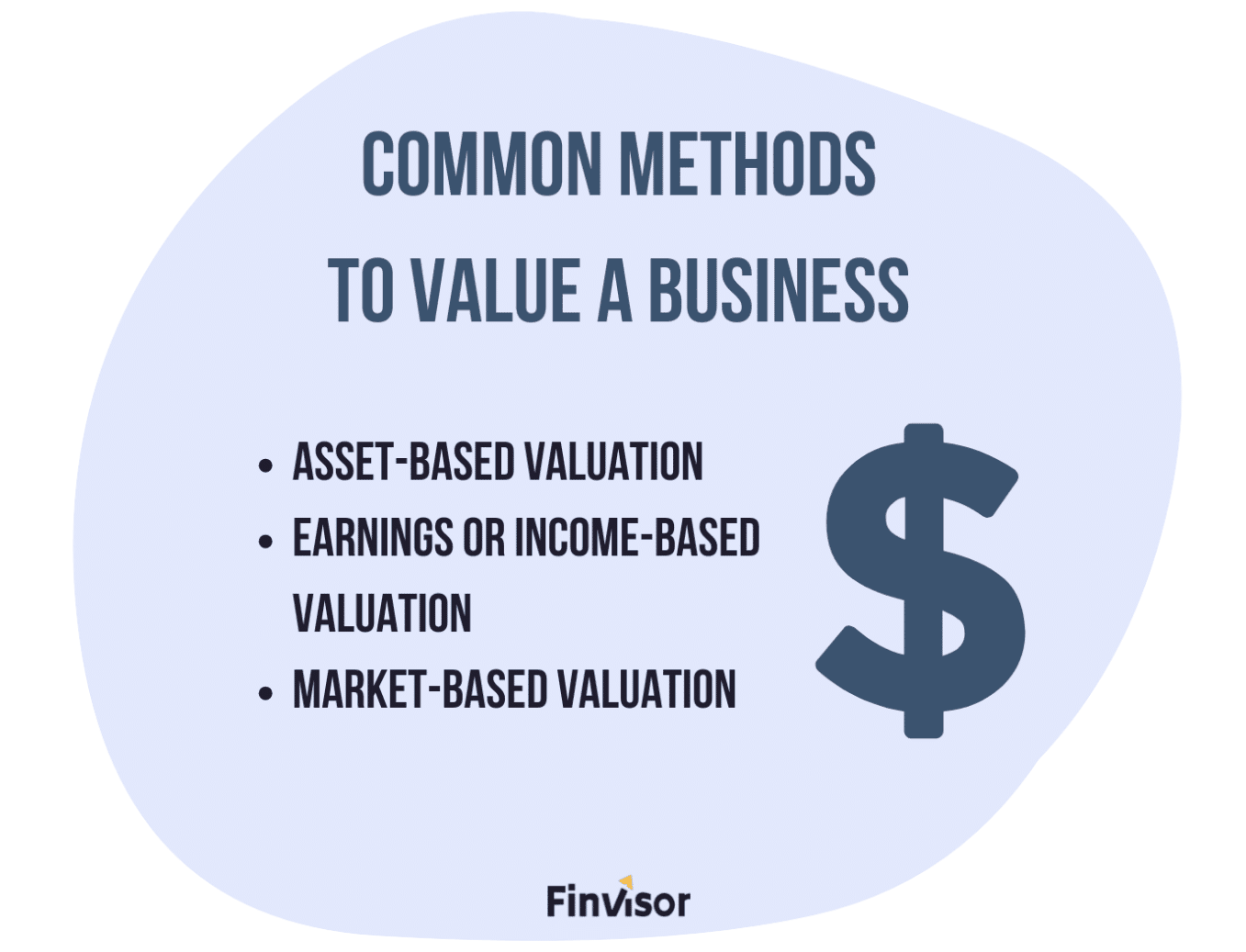
Asset-Based Valuation
This approach is best for asset-heavy businesses. If you have a large amount of inventory, equipment, or real estate, this could be the best method for you.
This method works by subtracting a company’s total liabilities from the total of its assets.
There are a few ways to conduct an asset-based valuation in business:
Liquidation value: This determines the value when assets are sold off quickly, usually at a discount. This method is used if the company is in distress.
Replacement value: This determines the cost to replace assets at the current market prices, including any operational and setup costs. This gives a higher valuation than the liquidation method because the assets are valued at market rates rather than a discount.
Going concern value: This places a value on assets based on their ability to generate future cash flows. Use this if your business is healthy and in a good financial position.
Earnings or Income-Based Valuation
The earnings or income-based valuation is based on a business’s ability to generate income. Again, there are a few different methods used to work this out:
Discounted cash flow: This estimates future cash flows and then discounts them to give the value. This method is typically used for businesses with growing or variable earnings.
Capitalization of earnings: This takes historical earnings and applies a capitalization rate to determine the present value. This method is best for stable, mature organizations.
Earnings before interest, taxes, depreciation and amortization (EBITDA): This measures the profitability of operations and is a common method for medium to large-sized organizations.
Seller’s discretionary earnings (SDE): This is based on the total available cash flow, including discretionary expenses and owner compensation. This method is ideal for smaller companies where the owner is central to business operations.
Market-Based Valuation
To gain a market-based valuation, you have to compare your business to similar companies that have been sold recently. You can also compare to publicly traded companies.
This approach relies on market data and applies relevant multiples to the business’s metrics, such as price to earnings or price to sales.
Overall, market-based valuations work best for medium to large businesses where there is enough data available to make meaningful comparisons.
There are two main ways to do this:
Precedent transactions method: This uses multiples from the sales of similar organizations.
Guideline public company method: This takes multiples of publicly traded companies based within the same industry.
Key Factors That Affect Business Value
There are many factors that will affect the valuation. Business owners should take these into consideration when determining how much their company is worth.
Revenue and Profitability Trends
A healthy business will have consistent revenue and growing profitability. Positive trends in these areas indicate that the business is sustainable and profitable, which ultimately increases the value to potential buyers.
Investors also look for strong revenue and profit trends because they present a much safer bet for funding.
Customer Concentration and Retention
Potential buyers prefer to see a large, loyal, diverse customer base. This strengthens the value of your business and signals long-term stability.
A business that relies on a few larger customers increases risk and lowers the company’s value, as profits will noticeably suffer if a customer leaves. Logically, a business in which one customer accounts for more than 20% of the incoming revenue raises concern.
Buyers also look for low churn rates and high retention rates. This indicates that the products sold are of high quality and sustainable over the long term.
Industry Outlook and Competition
A business that operates in a saturated or competitive market will not gain as high a value as one that operates in an industry with strong demand. The exception is if the business has a clear competitive advantage.
In general, the greater the demand, market size and positive trends, the higher the business’s value.
Owner Dependency and Leadership Team Strength
Business owners work hard to make sure their company succeeds, but too much dependence on a single person can hurt its value. This is considered risky, as daily operations may falter if the owner isn’t present.
In contrast, organizations with independent management teams are seen as stronger and more sustainable.
Implementing a proper leadership structure that is not overly reliant on a single person will increase buyer confidence and result in a higher value.
Intellectual Property, Proprietary Assets and Tangible Assets
Everything the business owns can be considered a factor that contributes to the overall value. Here are some examples:
Patents: These can raise the value because they provide legal protection for unique products or processes. Patents can command a higher market value and reduce competition.
Trademarks: These protect brand identity, which supports pricing power and customer loyalty.
Copyrights: Copyrighted material secures rights to creative work that generates revenue.
Proprietary technology: Provides processes that competitors can't easily replicate, giving the business a competitive edge.
Intangible assets: Brand reputation and customer relationships are incredibly valuable. They can mean more predictable revenue and repeat business.
Tangible assets: Equipment, real estate and inventory all contribute toward the value of the business.
Common Misconceptions About Business Valuation
“My business is worth all the time and energy I’ve poured into it.”
While valuing a company may at first seem like numbers on paper, emotional bias can play a surprisingly strong role.
Many business owners place high sentimental or emotional value on their company, leading to higher expectations and unrealistic prices.
Owners also have a tendency to focus exclusively on the strengths of the business and often fail to take weaknesses or issues into consideration.
In reality, buyers rely on the data and facts on the paper in front of them, not the owner’s personal needs or the years-long journey they’ve worked to build a profitable business.
“A buyer will see the same value I do.”
This misconception is also born from emotional bias. It’s a harsh truth, but no one will buy your business just because you have an emotional connection with it and see it as valuable. A buyer or investor’s interest lies solely in risk, ROI and market comparables.
This gap in perceptions is often the largest contributor to disputes around the value of the business.
“It’s just based on revenue.”
A company’s worth is not based on revenue alone. As we have demonstrated, many factors contribute to the overall value.
While revenue is important, buyers and investors place more importance on how sustainable a company’s profits are and what the future cash flow looks like.
“My business is worth what I need for retirement.”
Your business is worth what the market conditions, financial performance and buyer demand say it’s worth. Your own personal financial needs do not play a role.
Again, focusing on your own goals can lead to unrealistic expectations, so don't rely on selling your business as your only means to cover your finances during retirement.
When Should You Get a Valuation Done?
Getting a valuation is not a one-and-done thing. Factors such as market conditions and trends are variable, so today’s price likely won’t reflect next year’s.
You should always aim to get a valuation every one or two years to serve as a benchmark for financial health and growth. Not only that, valuations reveal areas for improvement, so you can work to correct them and add more value to your company.
Additionally, regular valuations are required to support strategic planning and ensure you have the information on hand when you need to make major decisions such as:
Sales, mergers and acquisitions: To determine a fair price and negotiate favorable terms.
Partnership adjustments or adding shareholders: To establish the value of ownership interests for new or departing partners.
Divorce or legal disputes: To determine asset division or to resolve disputes.
Finally, always get a valuation when seeking investment or financing. It will build your credibility as a business owner and help secure better terms.
Conclusion
Business valuations form a part of your strategic financial planning, and they are essential for securing the long-term growth of your organization.
Therefore, it’s best practice to be proactive and make regular valuations part of your routine. The process might seem daunting at first, but once you’ve selected the right method and done it a couple of times, it becomes much easier.
Plus, there’s always help on hand if you need it.
At Finvisor, our financial professionals will assist you in all aspects of financial planning and decision-making. Our on-demand services ensure you get access to the right expertise whenever you need it.
Beyond valuations, Finvisor can help you with general accounting, CFO services, compliance, payroll and benefits, and more. Our services are scalable in line with your business needs, meaning you only pay for what you actually require.
If you’re interested in having Finvisor help you with a business evaluation, then we invite you to get in touch. We are happy to answer your questions and provide you with a free quote.
Let us support you and help take your business to new heights!


