
Running a business involves making decisions every single day. But without the right financial data, it’s hard to know whether you’re making the right ones.
Using financial key performance indicators (KPIs) is one of the best ways to help guide your future decisions, as it provides a quantifiable way to measure your past performance against specific, strategic goals.
Moreover, stakeholders and potential investors also like to review these metrics because they provide a clear and objective snapshot of your company’s financial health.
But as important as KPIs are, many businesses fail to use them to their full potential.
By having someone on your team who understands which KPIs matter, how to interpret them and how to apply them to your decision-making process, you can turn financial KPIs from dashboard metrics into powerful tools for future growth.
That said, before exploring how to apply KPIs strategically, it’s important to understand the main categories your business can track.
What Are the Main Types of Financial KPIs?
There are dozens of potential KPIs that your company can use. They typically fall into a few categories:
Profitability KPIs: How effectively does your business convert revenue into profit? These KPIs look at how profitable you are.
Liquidity KPIs: Can your company meet your short-term obligations using your cash flow and assets? These KPIs assess your immediate financial health.
Efficiency KPIs: How quickly are you running through your working capital during a defined period of time? These KPIs look at the turnover rate of your accounts and inventory.
Leverage and Debt KPIs: How much of your financing is coming from debt? These KPIs look at how your company is financed, as well as how easily you can pay back your debt.
Growth KPIs: How fast is your business growing? These KPIs track whether your business is scaling sustainably, and whether that growth translates into usable cash flow.
There is no one “best” mix of KPIs for all companies. The right metrics for your business will largely depend on your current growth stage, size and industry.
But with so many KPIs to choose from, how can you know you’re selecting the right ones? The answer lies in having the right financial leadership.
Without that guidance, many businesses struggle to use KPIs effectively.
Why Many Businesses Struggle to Use KPIs
Since most financial KPIs are fairly simple ratios, they should be straightforward to use and understand, right?
In practice, it’s not always that simple. Many businesses struggle to use KPIs effectively for a few reasons:
They’re Using Too Many KPIs
Some people are tempted to use as many metrics as possible. Automated dashboard tools make it easier than ever to view dozens of KPIs in real time. However, if you don’t know what any of those numbers mean, it can be overwhelming to figure out what to do next.
They Lack Context
Some business owners fail to take their industry and company history into account. Is a gross profit margin of 35% good or bad? Without looking at past benchmarks or understanding your industry, this number is meaningless.
There’s No Strategic Plan
Even if you understand what KPIs mean, without expert insight you may still lack clarity on why your numbers look the way they do and what they indicate for your company’s future.
How a Fractional CFO Service Can Help Your Company
Financial KPIs are most valuable when they’re actively informing your company’s day-to-day decisions and strategy.
A fractional CFO provides the context needed to ensure your KPIs are meaningful and aligned with your company’s goals.
Here’s why many startups and small businesses choose to work with a fractional CFO service.
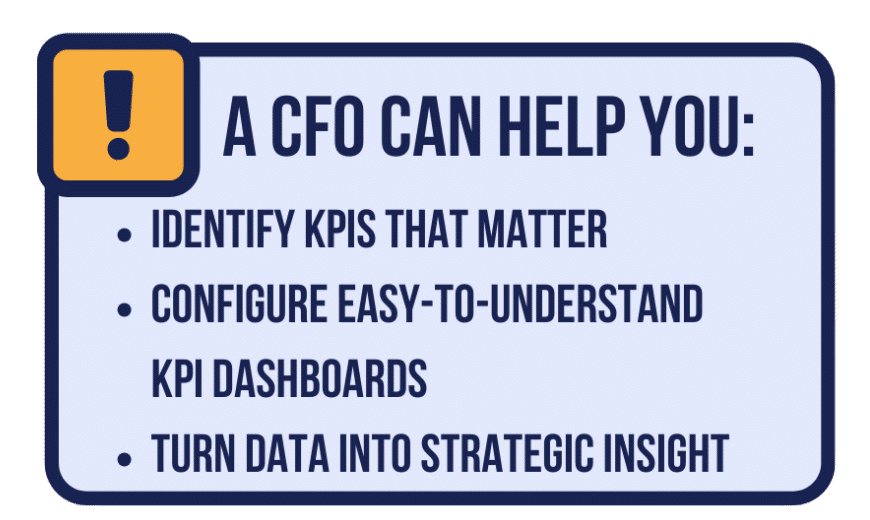
Identify KPIs That Matter
Businesses shouldn’t track every possible KPI. Not all metrics matter for every stage of growth, or for every industry.
A fractional CFO will take into account your business model, growth stage, industry, goals and more to determine what KPIs will actually be relevant to you.
For instance, an early-stage tech startup with limited cash flow would benefit from tracking burn rate, cash runway and customer acquisition cost.
On the other hand, an established brick-and-mortar retail store would be better off prioritizing metrics like inventory turnover and cost of goods sold.
Your business is unique, and so are your metrics. Your fractional CFO will help you build a custom KPI dashboard that’s perfectly aligned with your company’s structure and goals.
Configure Easy-to-Understand KPI Dashboards
KPIs should be easy to use and understand, not bogged down by too much information or buried away in your spreadsheets. If you can’t easily interpret what your dashboard is showing, you can’t readily use it to inform future decisions.
A fractional CFO will help you organize and consolidate all of your financial data, making it easier for you to utilize. They’ll ensure your KPIs are reviewed consistently and clearly tied to your company’s strategic objectives.
Turn Data Into Strategic Insight
KPIs can be difficult to interpret on your own. Fractional CFOs do more than just tell you numerical data. They also give you insight into the hows and whys of your metrics, summarizing numbers and trends into plain words you can actually understand.
They’ll be able to give you expert advice, helping you make more informed strategic decisions and set goals that make sense.
Does Your Business Need a Fractional CFO?
There’s no doubt that CFOs are a valuable resource for any company. However, hiring a full-time CFO is out of reach for many startups and small businesses. In fact, as of 2024, the median CFO salary is $363,559.
A fractional CFO bridges that gap, providing much-needed insight to companies that are working with tight cash flow. They’ll bring the same level of strategy and expertise as an in-house CFO, but on a part-time or project-by-project basis.
If you’re struggling to use KPIs efficiently, it may be time to bring a fractional CFO onto your team.
Finvisor provides fractional CFO and advisory services, as well as bookkeeping, accounting and more to startups and small-to-medium-sized businesses. To find out how we can help you with KPIs and more, get in touch with our team today.


