


Starting and running a small business comes with a long list of decisions, and one of the most important of these is choosing the right type of business structure.
Your business structure has a direct impact on the amount of personal risk you take on, how you’re taxed, the complexity of your operations and even your long-term growth potential.
Unsure which structure is best for your small business? This guide will break down all the critical factors you’ll need to keep in mind while choosing.
Key Factors to Consider Before Choosing
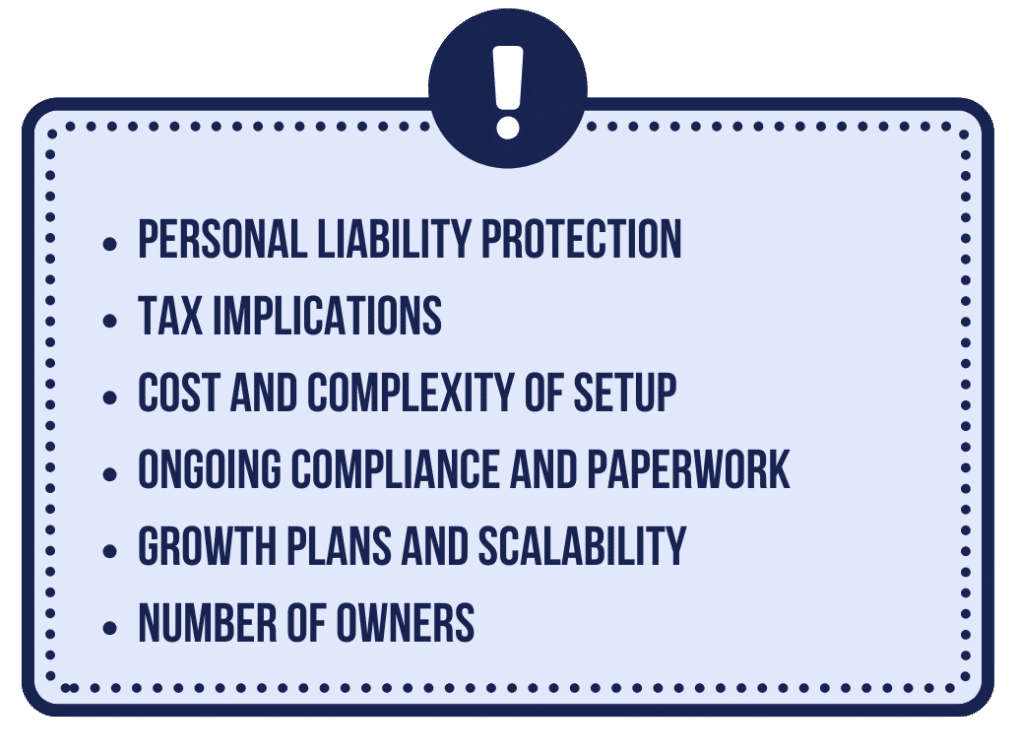
Each business structure impacts key areas in different ways. When looking at the different structures, these are the factors you must go through in detail.
Personal Liability Protection
This factor comes down to how much personal risk you’re willing to take on if the business gets sued or loses out financially.
Some structures, such as sole proprietorships and general partnerships, don’t distinguish between personal and business assets. Therefore, you would be exposed to unlimited liability for debts or lawsuits.
In practical terms, you could potentially lose your house, car and savings, not just your business property.
All other types of business structures keep personal and business assets separate, so if things go wrong, only the business assets are affected.
Tax Implications
Each business structure is taxed differently.
Most structures pass profits directly to you, meaning you report the income on your personal tax return and pay self-employment taxes on it.
However, a C corporation works differently. First, it is taxed at the business level, and then owners are taxed again when they receive payments (double taxation).
Subtle differences may make one structure more advantageous to you than others. While the cheapest taxation option might seem more appealing, it can actually cost you more in the long run if your business structure isn’t the right one.
Essentially, you must look at your income levels and deductions to determine which entity structure will be best from a tax perspective.
Cost and Complexity of Setup
As you can probably imagine, a simple business structure like a sole proprietorship can be set up quickly and with minimal outlay.
In contrast, more complex structures like corporations require extensive paperwork and legal assistance, which can cost you a lot more money.
While using a simple structure can save you time and money upfront, it can create hassle further down the line when your business outgrows it.
Dealing with a more complex structure is painful and can slow you down in the startup phase, but once it’s set up, you likely won’t need to change it.
Ongoing Compliance and Paperwork
Compliance and paperwork go hand in hand with all business structure types, although some are far more straightforward than others.
The more basic structures simply require annual filing. However, compliance requirements can increase in regulated industries, such as accounting, and there may also be location-specific rules you need to follow.
The more complex structures may require:
- Annual or quarterly filings
- Disciplined bookkeeping
- Formal records, including meeting notes, ownership structures and resolutions
- Detailed, regular tax filings
- Adherence to strict regulatory frameworks
A general rule of thumb is that the more personal liability protection you have, the more paperwork will be involved with running the business.
Growth Plans and Scalability
Where do you see your business heading over the next few years? And what about in the long-term?
Outgrowing a business structure costs time and money, and the transition may take many months to complete. You’ll likely have to fill out a lot of paperwork too.
However, failing to make a change when needed can also carry consequences. You may notice your growth slowing down or even stopping completely. Similarly, certain structures are less attractive to investors, so if you need funding, this path may be unavailable unless you restructure.
Even if you’re planning to stay small, it’s still worth considering a structure that gives you the option to grow.
Ask yourself the following questions to help you decide:
- Will you hire employees?
- Are you planning to bring in partners at some point?
- Are you likely to seek investors or funding?
- Is it your aim to sell the business one day?
Number of Owners
Finally, how many people will own the business? If it’s more than one, then you can’t choose a sole proprietorship and must pick another structure.
Some structures stipulate that all owners share in the management of the business, while others enable owners to have limited input.
Then there’s the question of whether or not you want shareholders. If so, then you’ll need to opt for a corporation.
Sole Proprietorship
A sole proprietorship is a structure in which a single individual owns and operates the business. There is no legal separation between the owner and the business entity.
Although it’s the simplest business structure, the owner bears full responsibility for all debts and obligations. Income is reported directly on their personal tax return.
- Best for: Freelancers and solo entrepreneurs
Pros
- A sole proprietorship requires very little setup. There is no requirement for a formal registration or filings beyond local licenses. That means they are cheap and fast to get off the ground.
- You get to enjoy having complete control over business decisions and how you run your operations.
- Pass-through taxation further simplifies things. You file business income on your personal 1040 form along with any potential expense deductions.
Cons
- There is a lack of personal liability protection. All personal assets are exposed and can be used to cover debts or lawsuits.
- Growth is limited because adding owners means a structure overhaul. Additionally, investors are typically not interested in giving capital to sole proprietors.
- Self-employment taxes on net earnings can add to the tax burden and could lead to missing out on corporate tax benefits.
Partnership
A partnership is a business structure in which two or more individuals agree to share ownership, profits, losses and management responsibilities. The co-owners have their income passed through to their personal tax returns.
General vs. Limited Partnerships
There are two types of partnerships to consider.
In a general partnership, all partners assume equal roles in management responsibilities. They also bear unlimited personal liability for business debts and legal matters, even if those arise from the actions of a co-partner.
Limited partnerships have an adjusted hierarchy. They must have at least one general partner who handles business operations and assumes liability. Then, there can be one or more limited partners who essentially act as passive investors.
A limited partner’s liability is restricted to their capital contribution, and the partnership requires state registration with a formal agreement.
- Best for: Businesses with multiple founders.
Pros
- Partnerships incorporate diverse skills, resources and capital, which drives growth and innovation faster than a sole proprietorship.
- Setup remains simple and low-cost and typically only requires a written agreement that establishes each owner’s role and obligations.
- Shared ownership allows collaboration for decision-making and broader networks for growth.
Cons
- Unlimited personal liability risks personal assets for business obligations or partner misconduct.
- Disputes over operations, profits and other factors can dissolve or significantly disrupt the business.
- Scalability is limited due to the complexity of adding partners. Investors are also reluctant to get involved due to the liability exposure.
Limited Liability Company (LLC)
An LLC is a flexible structure that blends the liability protection of a corporation with the simplicity of a sole proprietorship or partnership.
Owners are known as members and can include individuals, corporations or other entities. There’s no limit on the number of owners, though the rules governing this vary by state.
LLCs are governed by an operating agreement, which defines profit sharing and management structures.
- Best for: Small businesses or teams seeking protection and flexibility.
Pros
- LLCs protect members’ personal assets from debt and lawsuits and offer strong protection without the rigid structure of a corporation.
- Taxation defaults to pass-through, but there are options to move to S corp or C corp taxation to take advantage of various savings.
- Management and ownership structures are flexible and allow member-managed or manager-managed setups.
Cons
- LLCs require state filing fees for formation and annual reporting fees. Some states require ongoing franchise taxes.
- Compliance is stricter, with some states requiring registered agents, operating agreements and publications.
- LLCs with foreign ownership face additional qualification hurdles.
Corporation
The most complex setup, a corporation is a distinct legal entity and is considered separate from its owners. Therefore, there is also a strong separation between personal and business assets.
Corporations are formed by filing articles of incorporation with the state and must adhere to formalities, such as board meetings, annual reports and bylaws.
C Corporation vs. S Corporation
A C corporation is the default corporate structure and allows unlimited shareholders of any type (entities, non-residents, etc.). It can also have multiple stock classes for fundraising.
S corporations are elected via IRS Form 2553 and have a shareholder limit of 100 U.S. residents or citizens. One stock class is permitted, and pass-through taxation is available.
- Best for: A C corp suits scaling businesses that seek investment, while S corps fit smaller, owner-operated firms seeking tax relief.
Pros
- Both types of corporations offer strong liability protection and shield shareholders from personal asset loss.
- Corporations are strong for fundraising. C corps can raise funds via unlimited stock issuance, and both structures are desirable for investors.
- Perpetual succession ensures business continuity, even if the owner changes. This enhances credibility with lenders and partners.
Cons
- Corporations are highly complex and face extensive paperwork and compliance obligations. The associated costs are much higher compared to simpler structures.
- C corps face double taxation and must pay corporate tax plus tax on shareholder dividends.
- S corps have ownership restrictions and include payroll formalities for owners, potentially risking IRS ineligibility.
Comparing Business Structures at a Glance
Here’s a table to quickly compare the different types of business structures:
| Sole proprietorship | Partnership | Limited Liability Company | Corporation | |
| Number of owners | One | Two or more | One or more | 100 max or unlimited shareholders |
| Setup complexity | Low | Low | Medium | High |
| Liability | Unlimited personal | Unlimited personal | Limited | Limited |
| Taxation | Personal + self-employment | Pass-through | Pass-through (flexible) | Double taxation or pass-through |
| Management | Owner retains control | Shared control or limited control | Established via an operating agreement | Shareholders elect a board of directors |
| Best for | Freelancers and solo entrepreneurs | Businesses with multiple founders | Small businesses seeking protection and flexibility | Scaling businesses that seek investment |
Common Mistakes to Avoid
When considering the different business structures, here are the pitfalls you should take care to avoid:
- Liability vs. risk: Many fail to consider the level of risk for the various business types and structures. High-risk businesses should choose a structure that provides liability protection, while low-risk ventures can afford to take on personal liability.
- Tax fit: People often choose a structure without fully understanding the tax implications, which can lead to higher tax bills. Look at the whole picture, including tax liability, deductions, credits, potential tax savings and whether the structure involves double taxation or pass-through taxation.
- Neglecting growth plans: Opting for simpler structures without considering growth can stifle progress and fundraising opportunities. Restructuring is costly and time-consuming, so pick a structure that aligns with your growth plans.
- DIY structuring: Skipping professional advice on business setup often means overlooking state-specific requirements or more optimal structural options. This can lead to fines, lost tax benefits and so on. Consulting with an accountant or lawyer will pay off by helping ensure your business remains compliant.
How to Change Your Business Structure Later
Business structures can be changed, and many companies go down this route once they outgrow their current setup.
This is a very general overview of the process:
- Register the new entity with the appropriate authorities
- Update the tax registrations and business licenses
- Notify banks, clients, vendors and insurers of the change
- Transfer assets, contracts and accounts from the old entity to the new one
- Amend contracts and agreements
- Close or formally dissolve the old structure (if required)
In some instances, such as moving from a sole proprietorship to an LLC, the process can be relatively straightforward. However, moving to more complex structures, such as a corporation, takes a significant amount of work.
Moreover, restructuring can often trigger unexpected tax or legal obligations. Therefore, it’s important to consult with an accountant or legal professional before making the switch.
For advice and assistance with setting up or restructuring your business structure, we invite you to get in touch with Finvisor. Our qualified professionals can guide you through the process and ensure you select the right setup for your circumstances.
We specialize in a range of industries and offer a wide selection of financial services to help your business grow.

Let's chat
Get on our calendar for a free introductory call.Find out what it's like to work with Finvisor and how we can help you reach your business goals. Our financial advisors work hard for your business across our full suite of accounting and reporting services.
Request a Quote
We'll get back to you within a business day, usually sooner. Or you can schedule an introductory call and get on our calendar."*" indicates required fields
