


Accountants deal with some of your company’s most sensitive personal and financial information: tax returns, payroll data, bank account details and more.
While this information is essential to assist you with all things financial, it is also incredibly valuable for cybercriminals.
Data breaches are on the rise, and financial services are especially at risk. In the first half of 2025, the financial services industry was the most frequently compromised, with 387 breaches.
For this reason, data protection is a major concern when choosing an accountant to support your business, whether you’re hiring someone full time or working with an outsourced service on an as-needed basis.
No business wants its data compromised, especially by someone trusted to keep it safe. Understanding how professional accountants protect their clients’ data can help you make a more informed decision about who to trust with your own financial information.
What Data Is at Risk?
To do their jobs effectively, accountants need access to a lot of personal information and detailed financial data.
Depending on the scope of your services and what you’ve hired your accountant to do, they might have access to personal information like:
- Full names
- Addresses
- Social Security numbers
- IP addresses
- Client and vendor contracts
- Insurance information
Personal information like this is commonly stolen for identity theft and fraud. For this reason, it should be kept just as secure as the financial data your accountant has access to, which may include:
- Prior years’ tax returns
- W-2 forms
- 1099 forms
- Income and revenue information
- Bank account information
- Credit card information
It’s a lot of sensitive data. Needless to say, if it were to fall into the wrong hands, it could have a multitude of devastating consequences for your business.
Why Does Data Protection Matter?
Data protection isn’t just a nice bonus feature for accounting firms to offer their clients. Accountants have both a legal and moral responsibility to keep all your data safe, at all times.
To meet that responsibility, accountants must follow IRS regulations, data privacy laws and industry-specific compliance standards. Failing to follow these regulations or protect client data can result in fines, penalties, lawsuits and reputational damage.
But compliance is only part of the picture. Data protection is also about trust.
You’re trusting your accountant with your finances—the backbone of your business operations. A data breach can disrupt your business, expose you to fraud and create costly problems for your team.
Data security also impacts your own clients’ trust in you. If you’re involved in a data breach, even one caused by a third-party service, your reputation may suffer as a result. Clients, investors and partners may lose confidence in your ability to safeguard sensitive information.
For that reason, strong data protection is essential, and your accountant should prioritize security at all times.
How Do Accountants Protect Your Data?
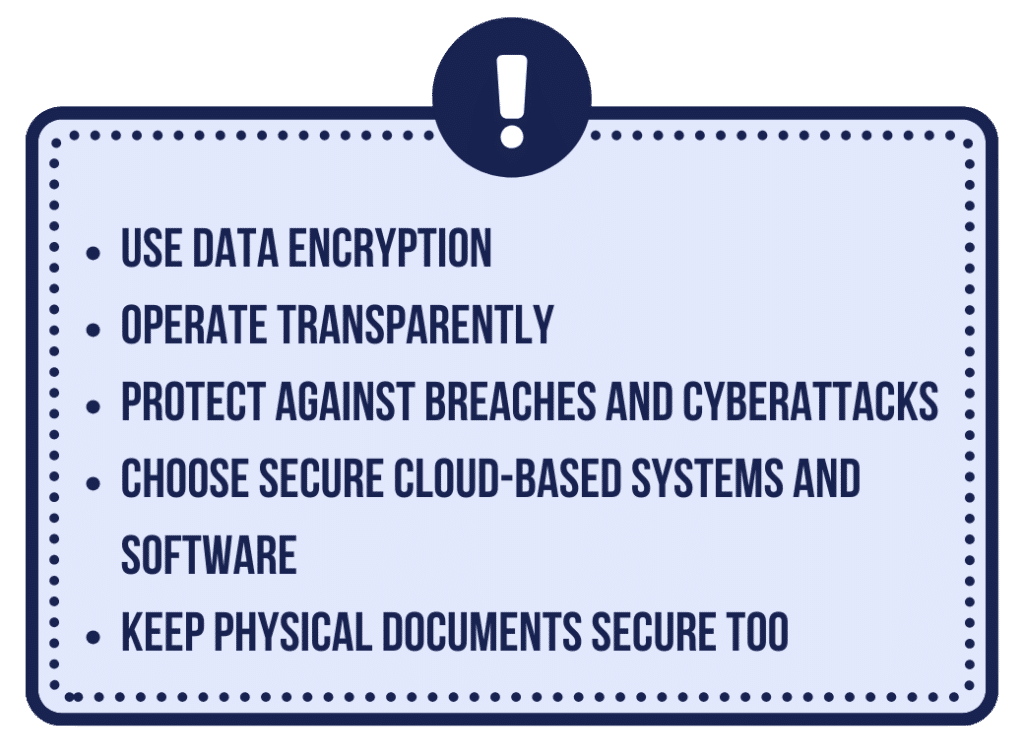
Professional accounting firms use a variety of technology and best practices to reduce the risk of sensitive information being compromised. Here are some of the key measures they use to keep client data secure.
Use Data Encryption
Encryption is one of the most effective ways for accountants to protect their clients’ information online. Encrypted data is unreadable to unauthorized users, even if it is accessed or intercepted.
Many cloud-based accounting software solutions use end-to-end encryption, which means that data is protected both when it’s being sent and when it’s being stored as a file. This significantly reduces the chance of a data breach at all times.
Your accountant should prioritize keeping all software up to date, which helps patch any loopholes that cybercriminals can use to get access to data.
Operate Transparently
Any reputable accountant will be transparent with their clients about what data they’re collecting from you, as well as how they’re using and storing it.
This may take the form of:
- Accessible privacy policies
- Secure document-sharing processes
- Well-defined access controls
- Clearly written data handling policies and procedures
Your accountant should also be open to answering any questions you have about data security. Transparency allows you to better understand how your information is being used and protected, and it helps strengthen trust within your working partnership.
Protect Against Breaches and Cyberattacks
Online threats are constantly evolving, and accountants must stay ahead of them to keep their clients’ data safe.
Many firms choose to implement a multi-layered security strategy, including:
- Using secure software and keeping it updated
- Using tools to pre-scan all emails, files and messages for potential scams
- Creating strong passwords
- Turning on multifactor authentication for all accounts
- Following all company data security protocols precisely
Most importantly, accountants should receive ongoing cybersecurity training. Human error is one of the most common causes of data breaches, and everyone within the organization needs to stay alert for potential scams.
Choose Secure Cloud-Based Systems and Software
Accounting firms are increasingly turning to cloud-based software and security solutions, and for good reason.
In many ways, these systems can be even more secure than on-site ones. They offer better monitoring capabilities, instantaneous updates and more ways to prevent data theft and loss.
They’re also convenient for businesses seeking fractional or outsourced support, as they allow both you and your accountant to access your accounts anytime, from anywhere.
However, not all software offers the same security. Before bringing on an accountant, ask them about their software and systems. Their solutions should have strong security standards, secure data backup capabilities and role-based access controls.
Keep Physical Documents Secure Too
While it’s easy to assume that most processes are now digital, many businesses still rely on physical documents, which can be just as vulnerable to theft and loss as digital files.
Your accountant should store all client files in locked cabinets, accessible only to authorized personnel. Additionally, any old files should be shredded and disposed of in a secure, professional manner.
Choose the Right Accountant to Keep Your Data Safe
A good accountant is more than a service provider, they’re a partner who treats data protection as a core responsibility. They’re the person you’re trusting to support your business through tax season and beyond.
At Finvisor, we specialize in providing secure outsourced accounting solutions that your business can trust. We use reliable cloud technology and platforms, making our services ideal for startups and small businesses just like yours.
Reach out today to learn more about our accounting services and how Finvisor works to help you reach your business goals.

Let's chat
Get on our calendar for a free introductory call.Find out what it's like to work with Finvisor and how we can help you reach your business goals. Our financial advisors work hard for your business across our full suite of accounting and reporting services.
Request a Quote
We'll get back to you within a business day, usually sooner. Or you can schedule an introductory call and get on our calendar."*" indicates required fields
